
On Saturday 12th November, as part of the ESRC Festival of Social Science, the DRY Project led a walk along the River Don in the centre of Sheffield. The DRY project team were accompanied by professional photographer Jack Perks and local historian Tim Cooper to allow our attendees to learn about photography and discover more about their local area and water courses. Fortunately the mild weather held out and we were able to stay dry as we completed the route.

We began the walk at The Riverside Pub on the edge of the regenerating Kelham Island zone. From here the short walk into the city centre demonstrated Sheffield’s ongoing flood management developments, with further flood defences being installed close to the new city centre developments.
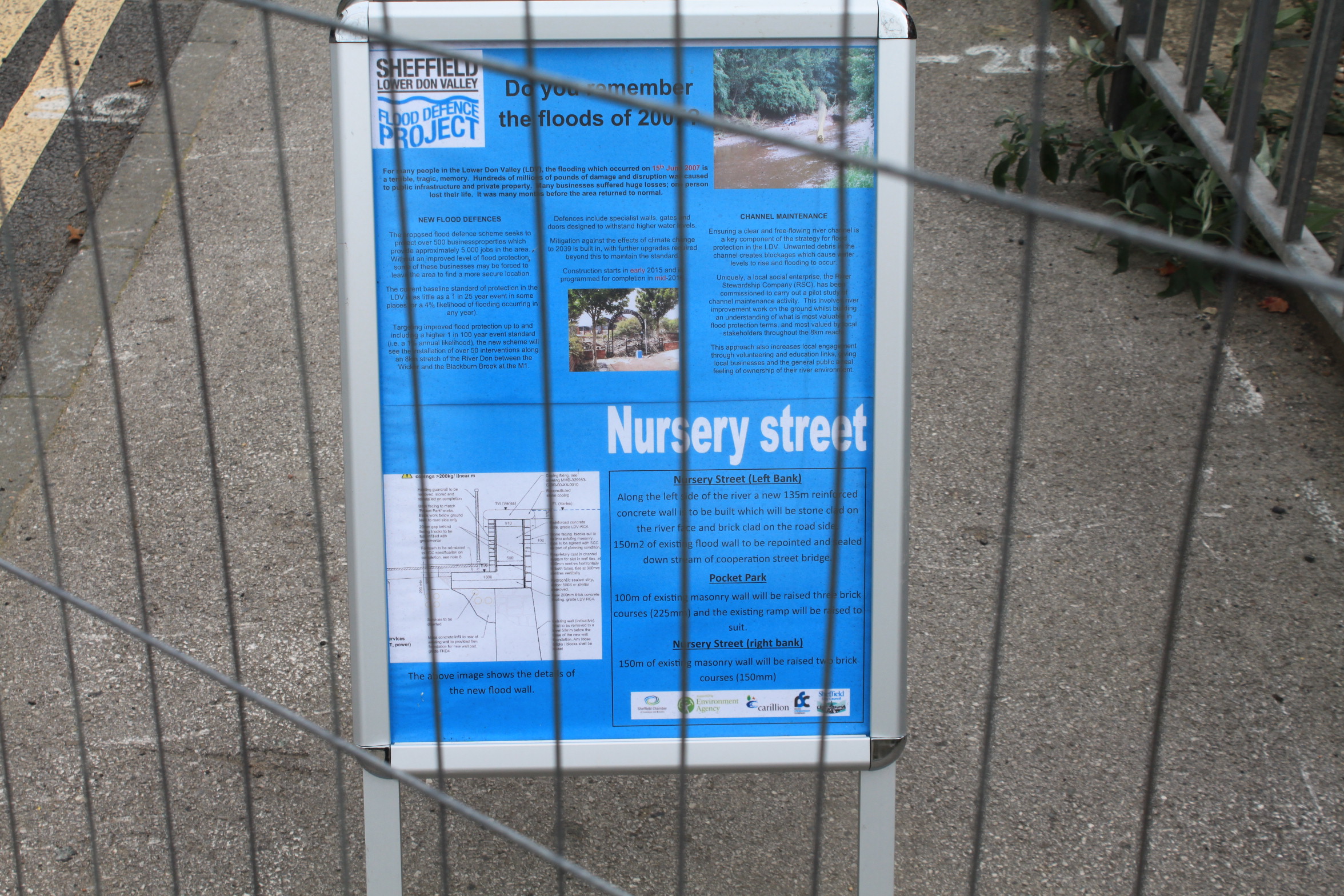
Flood defences being installed on Nursey Street and a call for flood memories
From Nursery Street the walk passed over Lady’s Bridge, Sheffield’s oldest bridge where the original structure is still intact and was constructed in 1485 has since been overlaid by an iron frame. On the route from the bridge out towards the five weirs walk a Kingfisher was spotted and our attendees were able to put their new photography skills to the test. Following on from this route we were able to see an amateur sculpture exhibit. Local anglers and photographers told us that these structures were constructed by a single, anonymous man wading into the river. The first structure appeared in July and several others have emerged over the past four months.

Lady’s Bridge and the low water level in November

River Art in the Don
As we continued along the route the urban architecture revealed a series of contrasts which reflects the piecemeal approaches to planning in Sheffield. The ‘spider bridge’ proved popular with our walkers, many of whom were unware of its existence, but after emerging from the tunnels the contrast between Sheffield’s industrial past and emerging future became apparent.
A trip to the canal basin also revealed Sheffield’s disconnect to its waterways. Whilst there have been signs of regeneration and investment in the area, particularly with the development of hotels, the basin remains detached from the City Centre by low-arching bridges. It was not until we returned to Kelham Island that there was a sense that the River Don was actually part of the city.

Sheffield’s Canal Basin
Kelham Island has been the City’s main beneficiary from the regeneration boom, becoming a fashionable place to live and containing many of the city’s most highly regarded pubs. Around this area were tributes to the 2007 and 1864 floods, with the river levels captured on the side of the Fat Cat pub. New apartment blocks were built along the riverfront, with balconies overlooking the waterways. New residential developments here also showed commitment to water sustainability issues, including rainwater harvesting systems.

New Residential Developments in Kelham Island
After we returned to the Riverside our attendees reflected on their experiences of the river in Sheffield and the role of the waterways in the city. There is interest in the way in which the River Don has been rehabilitated from one of Europe’s most polluted rivers to becoming an environment where wildlife such as brown trout, salmon, roach and kingfishers could thrive, although discussion did focus on how the river remains ‘dirty’ and the areas around it do lack a coherent developmental plan. The River as a resource is seen as a missed opportunity, and along with the Canal seems to be ignored by planners and the general population. Whilst Kelham Island can be seen as a success story, the surrounding areas do not encourage further exploration of the river system, and due to the lack of coherent development there is difficulty in engaging the local community to hold events and bring the river back into the mainstream consciousness of the city.
With the difficulties and challenges facing the river and the most obvious water source in the city, community engagement around water issues can often be difficult. Sheffield experienced huge flooding in 2007 which is still on the mind of many of the local residents. Stories of being trapped on buses, damage to buildings, and of human injury and death were shared. Despite this recent flood episode, memories of the 1976 drought are still retold, and as one attendee put it, the return of the rains that ended the drought was ‘the first time I’ve been relieved to see the rain’. We do hope that Sheffield can develop a strategy to utilise its water resources and encourage its citizens to visit and use them. In an area recently hit by floods it is important that water is not seen as some kind of ‘enemy’ to be controlled through defences, but as a resource and a benefit to all, and understand the implications for when it is running low.
Thank you to everyone who joined us on the walk, and especially to Gill Hughes for this excellent reflection of the event.
by Dr Jonathan Morris
University of Sheffield Management School
Photos by Dr Antonia Liguori
Loughborough University – School of the Arts, English and Drama